Lord Caterham
The Secret of ChimneysLord Caterham, Clement Edward Alistair Brent, the ninth Marquis of Caterham, is the reluctant owner of Chimneys, a country house repeatedly drawn into political business and criminal investigation. He inherits his brother’s public reputation along with the estate, but not his appetite for influence: where the previous marquis made history over weekend parties, Lord Caterham longs to be left alone. His dry, increasingly explicit resistance gives the novel’s high-stakes intrigues a domestic counterpoint, and culminates in his decision to go abroad rather than host another scheme at Chimneys.
Identity and Inheritance
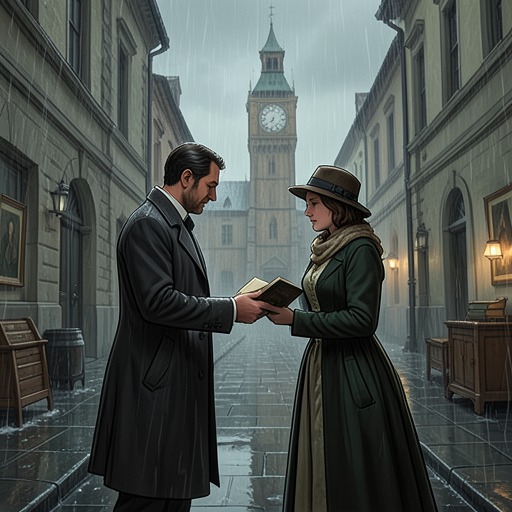
Lord Caterham is a small, shabby gentleman, marked by faded blue eyes, a thin, melancholy nose, and a vague but courteous manner. The appearance and manner unsettle the expected image of a marquis; he seems less a grand political host than a man trying to slip out of an unwanted interview. When George Lomax holds forth outside a London club, Lord Caterham repeats the same mild agreement three times, each time hoping to end the conversation and escape. His politeness is less assent than a practiced means of withdrawal.
The misfortune, as he sees it, is that four years earlier he succeeded his elder brother, the eighth marquis. The former Lord Caterham had been a prominent figure in national life, once Secretary of State for Foreign Affairs and influential in imperial councils. With his wife, a daughter of the Duke of Perth, he made Chimneys famous for hospitality: informal weekend gatherings there had helped shape events, and notable visitors from England and Europe had stayed at the house. The ninth marquis respects his brother’s achievements, but resents the assumption that Chimneys, because of that history, belongs to the nation rather than to its owner.
Chimneys and Political Pressure
That conflict becomes immediate when Lomax presses him to support the government’s delicate business involving Herzoslovakia. Lomax warns that a scandal could have grave consequences and insists that oil concessions must go to a British company. He proposes that the negotiations take place at Chimneys under cover of a shooting party, with Prince Michael Obolovitch due to arrive at the end of the week. Lord Caterham answers that he had been thinking of going abroad. Lomax dismisses the plan as absurd because it is early October; the exchange turns the country house into a venue imposed on its owner, rather than a home he freely offers.
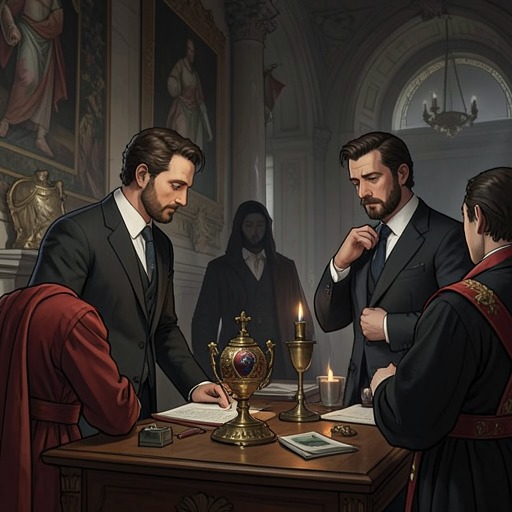
The same pattern persists as the murder investigation takes over the estate. In his small, cosy room, a refuge from Chimneys’ more imposing magnificence, Lord Caterham paces in visible agitation while awaiting the police and Dr Cartwright. He greets the arrival with relief, but his hands go through his hair until it stands in little tufts, making him look even less like a peer of the realm. Later, when he joins George Lomax, Colonel Melrose, and Superintendent Battle, he offers a vague explanation about duties on the estate and repairs for tenants before sidling apologetically into the room. His instinct is still to minimize his presence in public affairs, even when events have made withdrawal impossible.
The House Under Occupation
By the evening of 13 October, the house has become a gathering point for the people drawn into the mystery. As the council-chamber clock strikes nine, Lord Caterham surveys those returned to the room and compares them to a flock trailing back together. His mockery punctures the formal atmosphere: he privately labels the Baron an organ grinder accompanied by a monkey, and dismisses another guest as a busybody from Throgmorton Street. When Bundle defends the Baron’s praise of Lord Caterham as an ideal example of English hospitality among the haute noblesse, he concedes that the Baron often says such things, but calls him fatiguing to talk to.
The joke carries a genuine change in feeling. Lord Caterham says he is no longer nearly so hospitable as he once was. He would like to let Chimneys to an enterprising American and live in a hotel, where an unwanted visitor can be answered simply by asking for the bill. The preference is not merely for easier lodging: it reverses the inherited role that makes his house available to political visitors and a succession of people pursuing their own purposes.
When Anthony Cade arrives, he apologizes for causing him a great deal of trouble and says he believes the mystery will be cleared up that night. Lord Caterham is mollified; he has always had a secret liking for Anthony, and answers heartily that there is no trouble at all. His warmth toward Anthony stands out against his impatience with the larger company and its demands. Once the explanations are complete, Lord Caterham responds cheerfully that everything seems to have been cleared up satisfactorily, though Herman Isaacstein immediately points out that one matter remains unresolved. Even the apparent conclusion does not secure the quiet he wants.
Departure and Comic Reversal
The final prospect of another political entanglement prompts Lord Caterham to turn his longstanding wish to escape into action. He asks Bundle whether her car is in order, then instructs her to take him to town immediately: he is going abroad that day. When Bundle protests, he refuses to hear argument. George Lomax has arrived that morning wanting a private conversation about a matter of the utmost delicacy, and has added that the King of Timbuctoo is expected in London. Lord Caterham’s reaction makes clear that the new visitor’s identity matters less than the familiar pattern: Lomax’s discreet announcement is enough to predict another claim on Chimneys.
He declares that he will not go through it again, not even for fifty George Lomaxes. If the house is so valuable to the nation, he says, the nation can buy it; otherwise, he will sell it to a syndicate that can turn it into a hotel. Asked where Codders is, Lord Caterham checks his watch and calculates that the man can be occupied for at least fifteen minutes talking about the Empire. The final calculation reduces grand political conversation to a timed inconvenience, while his departure reverses the old history of Chimneys: once the stage on which powerful guests gathered, it may now be sold precisely to prevent such demands from recurring. The story leaves him acting on the impulse with which he began, but with his resistance finally made unmistakable.